
November 19, 2026 | Security Traders | Global Affairs & Strategic Intelligence
For the first time in history, the leaders of the United States, Russia and China have gathered for a formal trilateral summit, opening a new chapter in great-power diplomacy and potentially reshaping the future of global security, energy and international commerce.
Three Presidents. Three Superpowers. One Historic Meeting.
On November 19, 2026, an extraordinary diplomatic scene unfolded in Shenzhen, China.
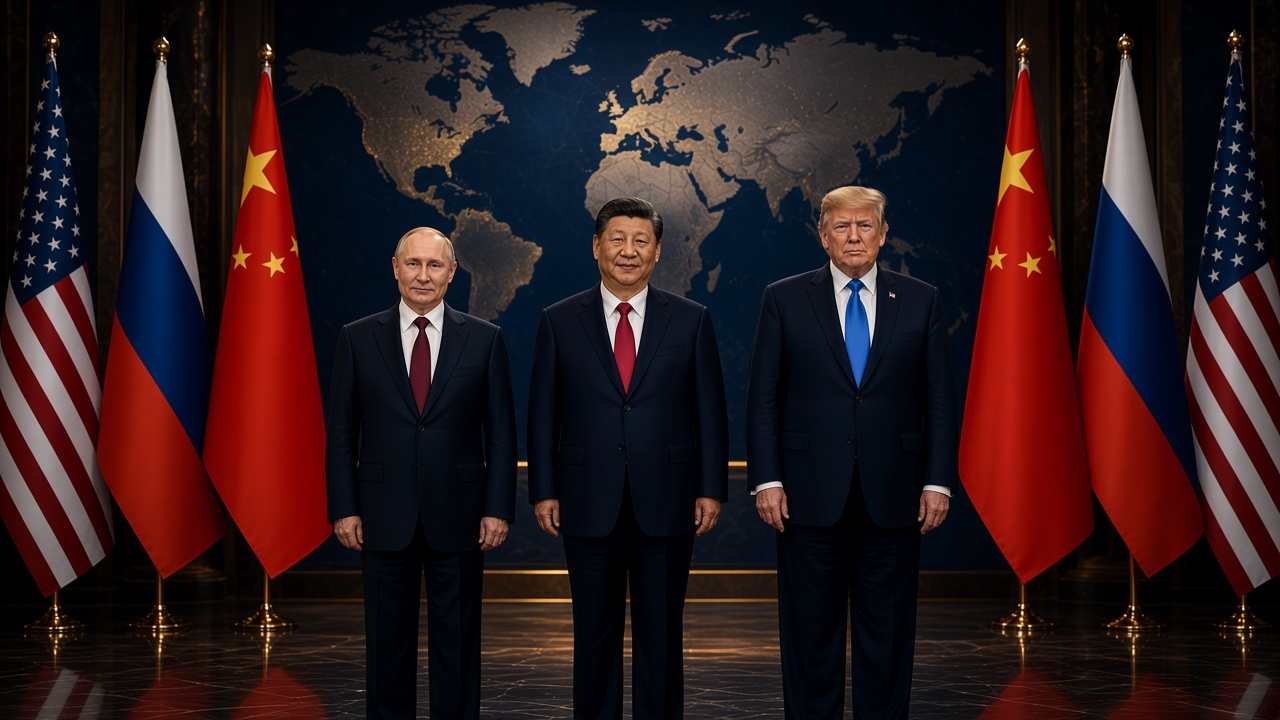
President Donald J. Trump of the United States, President Vladimir Putin of the Russian Federation and President Xi Jinping of the People’s Republic of China stood together beneath their national flags before participating in an unprecedented three-way summit.
The historic gathering took place on the sidelines of the Asia-Pacific Economic Cooperation (APEC) meetings in Shenzhen.
These three nations possess the world’s largest nuclear arsenals, among them overwhelming economic and military resources, and extraordinary influence over global energy, industrial production, financial markets and strategic supply chains.
Never before had their three heads of state convened together in this format.
The significance of the occasion extends well beyond the photograph.
For the first time, the leaders of these three competing powers formally shared a diplomatic table devoted to their common responsibilities for international security.
From the Cold War to Shenzhen: An Extraordinary Historical Journey
To appreciate the significance of Shenzhen, consider the diplomatic history that preceded it.
During World War II, the United States, the Soviet Union and China were among the major Allied powers confronting the Axis powers.
Yet the postwar international order quickly fractured.
The Cold War divided Washington and Moscow, while the Sino-Soviet split eventually drove Communist China and the Soviet Union apart.
President Richard Nixon’s historic 1972 visit to China fundamentally altered this geopolitical triangle, opening diplomatic relations and transforming the global strategic balance.
Over the following decades, Washington, Moscow and Beijing pursued bilateral summits, arms-control agreements, trade negotiations and diplomatic initiatives, often against a backdrop of profound ideological disagreement.
But the three leaders never shared a formal summit of their own.
That changed in Shenzhen.
The gathering represents an important departure from decades in which strategic dialogue among these countries was largely conducted through separate bilateral relationships.
The Declaration Toward Peace
Following the talks, the three governments issued a four-point Heads of State Declaration toward Peace, published by the White House.
The declaration identified four areas of common understanding:
- United Nations reform: A commitment to pursuing changes intended to make the United Nations more effective in responding to global challenges.
- Global energy security: An intention to increase the production and supply of refined petroleum products while supporting stable energy flows.
- State sovereignty and legal jurisdiction: Agreement on the importance of state consent and official immunities, alongside criticism of perceived abuses of jurisdiction by the International Criminal Court and similar institutions.
- Nuclear risk reduction: A reaffirmation that nuclear war cannot be won and must never be fought, accompanied by a commitment to dialogue on reducing nuclear dangers and preventing proliferation.
The fourth point may prove especially consequential.
The expiration of the New START nuclear arms-control treaty in February 2026 left Washington and Moscow without its former treaty-based limits on deployed strategic nuclear weapons.
China’s growing nuclear capabilities further complicate the international security environment.
A sustained trilateral discussion could eventually establish a framework for managing risks that bilateral diplomacy alone may no longer adequately address.
However, the declaration is not itself a new nuclear arms-control treaty, and the leaders announced no binding weapons-reduction targets.
What Shenzhen Means for Global Trade and Financial Markets
For Security Traders, one particularly important dimension of the summit is the connection between international security and international commerce.
Political uncertainty influences sovereign risk, commodity pricing, currency markets, energy contracts, shipping insurance and cross-border investment.
The three participating countries occupy distinct but interconnected positions in the global economy.
The United States remains central to international capital markets, dollar-based finance, technological innovation and global investment.
China is a major manufacturing and trading power, deeply integrated into global industrial supply chains and demand for raw materials.
Russia is a significant producer and exporter of energy, metals, agricultural commodities and other strategic resources.
Any durable improvement in communication among these governments could influence how international businesses assess geopolitical risk.
Three areas deserve particular attention.
Energy and Commodity Markets
The declaration’s specific reference to refined petroleum production and stable energy flows is commercially significant.
Energy disruptions affect everything from shipping and manufacturing to mining operations and infrastructure development.
Yet the statement contains no detailed production schedules, export commitments or sanctions agreements. Traders should therefore distinguish the diplomatic signal from measurable changes in physical supply.
International Capital and Investment
Reducing uncertainty between major powers could improve conditions for long-term investment, particularly in capital-intensive sectors such as energy, infrastructure, logistics and resource development.
But investors will need to observe actual policy decisions before concluding that sanctions, investment restrictions or trade barriers are changing.
Global Financial Infrastructure
International payments, settlement systems, reserve currencies and digital financial infrastructure have become strategic concerns.
A more predictable diplomatic environment could encourage new commercial dialogue. Nevertheless, the Shenzhen declaration does not establish any agreement concerning currency arrangements, digital assets, banking sanctions or cross-border payment systems.
These remain important areas for independent monitoring.
The Unfinished Business of Peace
Historic diplomacy should not be confused with an immediate diplomatic breakthrough.
Although the three leaders discussed major international security concerns, the declaration did not set out a resolution to Russia’s war in Ukraine, the conflict involving Iran or the tensions surrounding Taiwan.
Independent reporting also emphasized that several of the declaration’s commitments lack implementation details.
There are legitimate questions about whether reforms to international institutions would strengthen collective security or weaken existing mechanisms of accountability.
The treatment of the International Criminal Court is particularly contentious, given the conflicting positions of governments, international legal institutions and countries affected by ongoing conflicts.
The ultimate significance of Shenzhen will depend on what happens after the leaders leave the conference room.
Are new arms-control negotiations established? Do energy commitments produce measurable outcomes? Can the three governments create reliable crisis communications? Will diplomatic engagement lead to practical reductions in international tension?
These are the questions that will determine whether Shenzhen becomes a foundation for lasting cooperation or remains a powerful historical symbol.
The Security Traders Perspective: Diplomacy as Strategic Intelligence
Security Traders operates from a fundamental recognition: global commerce does not exist independently of geopolitics.
Capital moves through a world shaped by diplomacy, security, technology, regulation and access to natural resources.
For investors, commodity traders, financial intermediaries and international business developers, the Shenzhen Summit is therefore more than an event to watch on the evening news.
It represents a strategic development that deserves sustained attention.
The most valuable intelligence will not be derived from the symbolism of three leaders standing together, but from subsequent policy changes, commercial agreements and measurable reductions in international risk.
Security Traders will continue to examine these developments through the lenses of capital formation, international commerce, strategic resources and financial security.
November 19, 2026: A Date Worth Remembering
History is often remembered through remarkable images: leaders at negotiating tables, handshakes across ideological divides, and the signing of agreements that once seemed impossible.
The photograph from Shenzhen belongs to that tradition.
Three presidents representing competing geopolitical interests came together in recognition of their shared responsibility for avoiding catastrophic conflict.
Their differences remain substantial. Their agreement is limited. And their success is far from guaranteed.
But a diplomatic precedent has been established.
The Shenzhen Summit will be remembered as the day the leaders of China, Russia and the United States sat together at the same negotiating table for the first time.
Whether it becomes the beginning of a wider transformation in international relations will be determined by the agreements, actions and decisions that follow.
Security Traders — Following the intersection of global security, strategic capital and international commerce.
Sources and further reading
- The White House — U.S.-Russia-China Heads of State Declaration toward Peace
- The White House — President Trump, Xi and Putin Hold Trilateral Talks in China
- Associated Press — Takeaways from the Historic Summit
- China’s State Council — Xi Chairs Groundbreaking Summit